Showing posts with label FO2017. Show all posts

Tuesday, November 21, 2017

Some Good Stuff

It just occurred to me I neglected to mention I finished my Baltimore shawlette back in July, right before my summer went from being a bit too busy to plain crazy. Not to mention it was a positively steamy day in July when I blocked it, so I cooed over it, then put it away for cooler weather. It's cooler now, and I've been enjoying it.

Lionberry FO

The pairing of pattern and yarn was most enjoyable. The pattern, Lionberry by Narniel of Endor, has a little bit o' everything – lace and fancy texture, nicely curved crescent shape, just-right size. The tails of the shawlette fall in adorable ringlets. The yarn, Neighborhood Fiber Co. Capital Luxury Lace, colorway Del Ray, is a beautiful 80/10/10 MCN, so nice to knit. Ah, some good stuff... for a change.

Friday, July 28, 2017

Tabi or Not Tabi?

Gentle readers, behold what happens when one attempts to finish a pair of socks during a week of legislative drama but several months have intervened between sock the first and sock the second, one has a roaring headache, and one has forgotten what one was doing. The pair in question: a shortie, beaded-cuff version of Send in the Clowns by Adrienne Fong. I CO on Inauguration Day and finally BO last night. As it happens, it was not for the first time, for the socks or for another failed attempt to repeal Obamacare.

Tabi and not tabi

Oops. Happily, fixing a toe is no big deal. I just picked up stitches, unpicked the graft...

Toe going

... frogged back, and reconditioned the yarn. (That mushroom-cloud-like tangle seems like a fitting image for this crazy week.) The yarn, Scout's Swag 100% Superwash Merino, colorway Ballooney, was my very first club yarn, from way back in November 2007. It's lovely to knit with and comfortable to wear, but sadly is not durable.

Toe gone

My formula of 36% sts for the big toe and 64% sts for the rest worked out to 24 sts for the big toe and 40 sts for the rest when I re-knit a tabi toe.

Send in the Clowns FO

That's better.

Tuesday, June 27, 2017

Beyond Categorization

Per expectation, thus far the month of June has been a whirlwind of busy. If June were a mountain in a stage of the Tour de France, the term hors catégorie or HC – beyond categorization – would not be inappropriate. But there's no point in saying, "I told you so." Onward and upward!

Water bottle cozy

A minor annoyance amidst all the to-ing and fro-ing has been the persistent clanking noises emanating from my tote bag, caused by divers things striking my fancy stainless steel water bottle. To reduce the noise and to prevent damage to its finish, I went over to the dark side and crocheted a water bottle cozy from some Lily Sugar 'n Cream acquired on the fly at a big box store. (The colorway is Lava Lamp. Really?) There's no pattern, just granny-ing along. It works pretty well. Ah, blessèd freedom from clanking!

Dried Apricot Jam

The FIJ June challenge, jam, posed a vexing challenge at the beginning of the month: there's not a lot of fresh local fruit roundabout Exit 151. Thus the appeal of this unexpected recipe for Dried Apricot Jam. Although perhaps by now gentle readers know better than to be surprised that intrepid canners can put up almost anything. And although it's no surprise a plant-rich diet has a great impact on curbing global warming, according to the rankings in Drawdown, eating imported fruits and vegetables has less environmental impact than eating local beef. Put another way, a plant-based diet is so much better for the planet than red meat, transportation considerations become negligible. Also, while eating local seasonal produce is great taste-wise and it supports local farmers, it doesn't do that much environmental good. Huh.

Dried apricots, rehydrating

Anyway, the jam technique is simple: dice dried apricots, rehydrate overnight, cook down with sugar and a bit of lemon juice until jammy. (That's a technical term.) My poor digicam could not capture how variable in color and texture the rehydrating bits looked – some bits were almost white, wrinkled, and tough, some bits were deep orange and very soft. In the pot the bits broke down and deepened in hue in a most satisfactory way, and the results were excellent in all ways: delicious, convenient, and a spot-on yield. I put up one half-pint jar to use in jam cake and three quarter-pints for other uses. Happiness.

Time passed, and lovely fresh apricots became available in the markets. So I did the obvious, bought some fresh apricots with the intent of doing a jam-off. Unfortunately more time passed, and about half the apricots went bad before I could do that (oops, food waste). Ahem.

Fresh apricots

The recipe for Simple Apricot Jam is as minimalist as it gets: two ingredients, chopped fruit and sugar in a 3:1 ratio by weight, let macerate overnight, cook down. That's it. The formula works for other peel-on, high-acid fruit, too. I neglected to take a pic of the chopped fruit, but the bits were deeply colored and firm-textured, with velvet skin. In the pot everything cooked down into a beautiful golden paste that was thin at first, but slowly thickened into jamminess. The odor was heavenly.

Fresh apricots, boiling

I started with 27 oz. (.765 kg) chopped fruit and 9 oz (.255 kg) sugar, and ended with four quarter-pints and some well-licked implements.

Simple Apricot Jam

Initially I'd thought of a doing taste-off between apricot jam made from dried fruit and apricot jam made from fresh fruit. Now I know there's no comparison. Dried Apricot Jam is excellent; Simple Apricot Jam is early summer in a jar. I could tell by the smell when it was cooking down that it would be too good for putting in jam cake, so I changed the put-up to all small jars. One may as well call it HC Apricot Jam.

Saturday, April 1, 2017

Lent Socks

Happy April Fool's Day! This is a post-factum post, a catch-all catch-up, and it would seem the joke's on me. In true Seussical fashion, after I made shrub (also known as drinking vinegar or switchel) for the March FIJ Challenge (jellies and shrubs), I started seeing it here and there, I started seeing it everywhere. I saw it at an Asian supermarket (the signs say it's a healthy drink)...

Japanese shrub

... in a deli refrigerator case...

Switchel in deli case

... and at the Tait Farm Foods booth at the Philadelphia Flower Show. They were giving away samples, which tasted predominantly of fruit, sweet and tart, with that sour-funky vinegar flavor only at the finish. Quite nice, very refreshing. I bought a few bottles for research purposes.
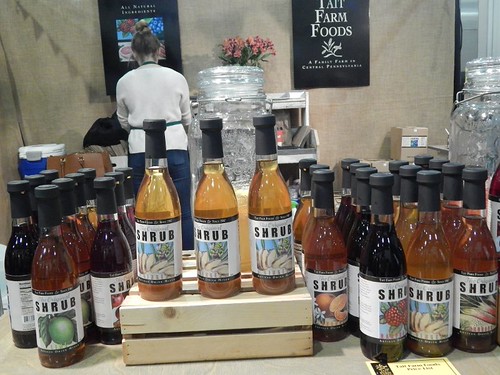
Tait Farm shrub

Alas, after much judicious sampling I have decided shrub just isn't my thing. I can see why some FIJ Challenge participants match a mix of 3 parts red wine vinegar and 1 part balsamic vinegar with strawberries or Braggs apple cider vinegar with citrus, pairings that would not have occurred to me before. So I'm happy to have expanded my palate and learned something new, even if I don't think I'll re-visit the topic. It does tug at my imagination, though, in ways that soup base does not.

Speaking of re-visiting topics, one February Sockdown category was repeats, so I knit another pair of lovely Embossed Leaves by Mona Schmidt, this one in Opal Uni-Solid, 2600 Purple. They're the liturgically correct color for Lent, and they're finished, although one day past the Sockdown deadline. Oh well. I tweaked the pattern a very little: substituted 2x2 ribbing, varied the pattern by a half-drop, fiddled with the star toe for fit. Otherwise, it's a beautiful and truly repeat-worthy pattern!

Embossed Leaves FO

For a second March FIJ Challenge project I made Wine and Herb Jelly by Cathy Barrow, using a Riesling Auslese instead of the Gewürtztraminer specified in the recipe. It was easy, pretty, and tasty, with a nice soft set and excellent yield; something to do at a time of year when there's not much fresh local fruit roundabout Exit 151. I put a sprig of thyme in the jars for decoration, but think the wine jelly would be equally good without it. The Auslese has such a luscious peach flavor, I suspect it might make an extra-luxurious and flavorful base for pepper jelly.

Wine and Herb Jelly

Obviously I'm having a lot of fun with the challenges. I'm particularly appreciative of the expertise and creativity of other participants, which leads to a phenomenon familiar from knitting: so many great recipes, too little time. It turns out almost anything can be made into jelly! Among the many recipes I'd like to try someday: Stout Beer Jelly, Grape Juice Jelly, Jalapeño-Confetti Jelly (in Preserving with Pomona's Pectin). As I don't much care for the massive quantities of sugar in so many traditional jelly recipes, I'd very much like to try Pomona's pectin, which would allow me to reduce the amount of sugar and let the fruit flavors shine.

Blood orange marmalade, March

I was down to one small jar of January's blood orange marmalade, so I made more. The January batch was rose-gold, but the March batch turned out ruby red. They taste about the same. Huh. I put up this batch in three 4-oz and three 8-oz jars to suit the excellent marmalade cake recipe – pity I don't have any 10-oz jars. Hm.

Saturday, February 18, 2017

Mark Bittman's Gravlax

The Food In Jars salt challenge is so wide-ranging, I had to try another recipe. Gravlax, or salt-cured salmon, seemed a natural. There's not much to say – I followed Mark Bittman's Gravlax recipe, using some techniques mentioned in the comprehensively informative Serious Eats recipe and essay, and a 2:1 salt:sugar dry brine. The required effort was minimal; some space in the fridge was needed. The results are excellent, luxuriously yummy.

Gravlax on cutting board

For this recipe the most important comments have to do with food safety. Salmon sometimes carries parasites that can affect humans, so the fish MUST be sushi-grade, that is, commercially frozen to render it suitable for consuming raw. And as this type of salt-curing is a fleeting preservation method, the gravlax MUST be eaten within five days of finishing its cure. Given the wide availability of "previously frozen fish" and the tastyness of gravlax, both safety requirements are easily satisfied.

Bittman's recipe says a 3-lb (1.36 kg) piece of salmon will yield 12 appetizer servings. A quarter-pound per person initially sounds outlandish, but it does seem most people if given half a chance will happily gorge on this stuff until surfeited, so the part that's mistaken is calling this an appetizer. At casa Jersey Knitter, there were suspicious mutterings when the curing salmon first appeared in the refrigerator, hogging so much shelf space, followed by impatient mutterings as it underwent its three-day cure, then more suspicion ("You try it first, and if you don't keel over..."), a sudden change of heart after that first amazing taste, then the soft noises of very contented feeding.

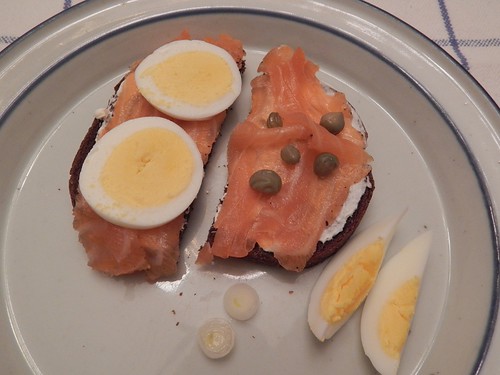
Gravlax plated

A bonus happiness is I used some of the overly salty vegetable bouillon to wash the raw salmon as described in the Serious Eats recipe. I was wondering what to do with it! We ate the gravlax with my own pickled nasturtium pods, which are similar to pickled capers, except they taste like pickled nasturtium pods (duh), flowery-mustardy-cresslike. I really must put up more... which means planting more.

I am definitely making more gravlax. I'd like to try the basic recipe with other fish, substitute shiso, an Asian pickling herb, for dill, tweak the dry brine mix. I used gin for the booze, which added a nice juniper berry note, and wonder what adding juniper berries to the rub will do. Mmm... so many things to try.

Brain hat wip

Meanwhile, fibery progress continues. I'm wishing I had a not-too-big stainless steel mixing bowl. They don't have much appeal as mixing bowls for me, but for craft purposes they're da bomb. Hm.

Wednesday, January 25, 2017

Small Batch Blood Orange Marmalade

Over the weekend I went to DC – not for the Inauguration of course, for the Women's March on Washington. But more on that in a later post. On my return, instead of sorting my march photos I cooked up another batch of marmalade for the January FIJ Mastery Challenge. While I liked my first effort, it seemed to me if the challenge is about mastery, then by definition a second attempt would be needed. This time I took a few more photos.

Blood Orange Marmalade

I used Marisa's Small Batch Blood Orange Marmalade recipe, which calls for soaking sliced fruit overnight to soften the peels and to encourage the pith to release its pectin. Because I wanted to use the marmalade in a recipe, Orange Marmalade Cake, that calls for coarse-cut peel, I made thick slices. Some blood oranges have deep purple flesh; mine had flecks of dark color, no more. After soaking overnight the overall color evened out and became pinky-orange.

Sliced fruit

After reading laments by other FIJ Challenge participants, it occurred to me that my thermometer may not be calibrated properly, something I've never tested. So I was very careful this time to note the volume in the pot at the start. The goal was to boil the fruit until volume is reduced by one-half. So I boiled...

Orange slices boiling

... and boiled (stirring to prevent sticking) until the blood orange slices looked quite wilted. The flesh of the oranges melted away, enriching the syrup and leaving the now-tender peels.

Orange slices quite boiled

My thermometer never went over 210° F (the standard is 220° F for two minutes), but it became clear the pectin was working pretty much when the volume in the pot was reduced by half. I tried the spoon test and the plate test, which didn't give unambiguous results, but somehow the hot marmalade just looked right, which may be one expression of expertise. There are no photos of this stage because there was much rapid flailing of implements in boiling hot sugar-fruit mixture. By the time the marmalade was in jars and ready for processing, it looked like the set was good – and so it was.

Blood Orange Marmalade

This time the yield was spot-on: three half-pints, or in my case six quarter-pints, plus a cook's share. The product was so tasty that one of the quarter-pints didn't make it to the class photo, and the flavor has only improved since then. It's hard to tell from the FO photos, but there are flecks of red amid the rose-gold marmalade, which is not what I would have expected, but is very appealing. And wouldn't you know it, having tried both it turns out I prefer julienned peel to coarse-cut. Although I haven't yet made the cake, so perhaps that may change (again).

Overall, I would say that while there remain many, many marmalade recipes to explore, marmalade success has been achieved, and I can move on to the February challenge without reservations.

Thursday, January 12, 2017

General Tso's Marmalade

On the Asian lunar calendar 2017 is the Year of the Rooster (technically starting on January 28). Over the summer I took this pic of a giant blue rooster to have to show off now-ish, but I didn't record and can't remember any details, which rather limits commentary. Ah well, Happy New Year!

Giant blue rooster

Apropos of the new year and in tribute to the recently departed Peng Chang-kuei, creator of General Tso's chicken, and for the Food in Jars Mastery Challenge (January is marmalade), I put up a half-batch of what I'm calling General Tso's marmalade. I love its deep orange color and intense orange flavor.

This was my first attempt at making marmalade. I blithely tweaked the original recipe which calls for Tabasco sauce by subbing red pepper flakes for a more Hunan-style flavor. Because it's a cut rind recipe, which eliminates much of the natural pectin in citrus, I was concerned about overly soft set and instead misjudged its done-ness, even with the aid of a thermometer. The set turned out so hard, the marmalade stays in place even if the jar is inverted. Oops. Initially the cook's share had very little fire, but as time passes it's getting hotter and hotter! Next time, I'd cut the peel into bigger pieces than the fine julienne I used this time, include more pith, and work for a softer set and corresponding higher yield.

General Tso's marmalade

The plan is to use the marmalade as a meat glaze. I tried the cook's share on lamb chops and like the flavor better than mint jelly. That texture, though, and the challenge of prising it out of the jar. Happily, the Food in Jars can-along community has suggestions (no crowbar needed!) – gentle warming in a water bath softens the marmalade nicely. The group also has historical perspective: in the Middle Ages, hard set was the standard. So my marmalade isn't too hard, it's medieval! Er, maybe that's not entirely positive either?

I'm not very fond of marmalade, or perhaps I should say I haven't been. Now that I've concentrated and preserved the essence of orange I will readily agree with Maggie Smith as the trenchantly snobbish Constance, Countess of Trentham, in Gosford Park: "Bought marmalade? Oh dear, I call that very feeble." Homemade is so much better than anything storebought that I've tried, there's truly no comparison.