Thanks to everyone who voted in the
evil computer name poll! After I tried swapping cables, wall outlets, surge protectors, hibernation schemes, etc, I was contemplating dubbing the beastie Lemon and
drop-kicking returning it, but found an unlikely suggestion on a troubleshooting website: disconnect the power cord, flip the voltage switch on the back panel from US to European voltage, wait 5 seconds, flip it back, plug in.

The simple fix seems to have tamed the powerup and powerdown woes. The little green light in back and the overly bright blue light in front turned on immediately, the computer hibernates on command, and 12 hours later there's been no nonsense about opening or shutting the pod bay doors.
Given this week's
SnB discussion of
hussy women and
other fun stuff, one hesitates to confess this, but... I tired of
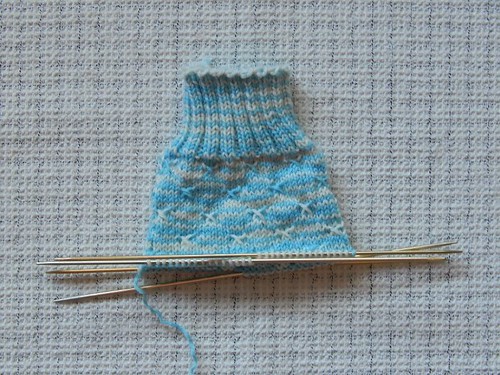
Handsome and swatched for the Myrtle Leaf shawl (p. 142 in
Victorian Lace Today) using Lorna's Laces Helen's Lace. Teehee.

The leaf lace is lovely to be sure, but... after knitblogless Eileen mentioned she plans to knit
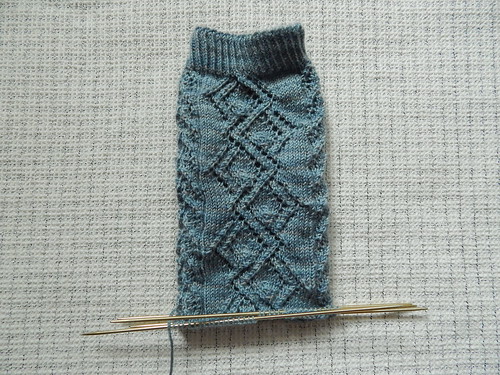
Kew, I thought I'd join her in making leaf lace socks rather than a shawl.
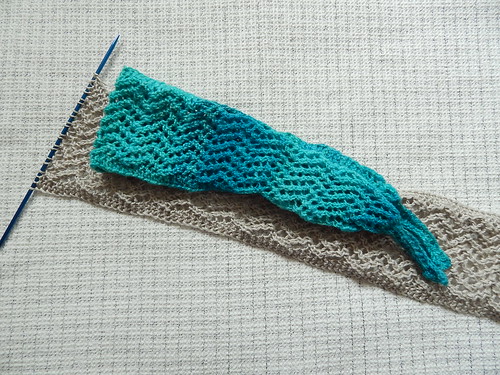
So I started a half-hexagon Spider's Web Fichu, p. 44. There's something irresistable about the shiny promise of a beaded edging (!).

The beads I plan to use call for a sporty look, so I'm using KFI Elsebeth Lavold
Hempathy, a blend of 41% cotton, 34% hemp, and 25% modal (reconstituted beech tree fiber, essentially a type of rayon). The yarn is two strands of multiple plies, which takes a bit of getting used to – it knits like string, yet the fabric is supple and light, with the best characteristics of its component fibers. The fibers reflect light differently, giving the yarn a beguiling gleam, softer than the brilliant shine of mercerized cotton or rayon. The yarn does not smell like hemp, which sometimes has an odor I find disagreeable.
The spider's web pattern is quick and easy to knit. It would be a good project for a newbie lace knitter, with the caveat that the expanses of stockinette stitch and the strict geometric lines mean even small variations in gauge or errors in stitch placement are glaringly obvious. I added another chevron, then decided it really isn't necessary (but wasn't about frog back to take it out).
As this is my second project from
VLT, a brief book review seems in order.

Overall, the projects in the book are lovely, covetable, and I plan to make several. Not one is beyond contemplation* for reasons of time, technique, practicality, or cost. The last chapter, Techniques, Tools, and Talk, equals the entire rest of the book in worth for the outstanding, very clear illustrations of stitch, blocking, and design techniques, the excellent lace yarn directory, and the author's commentary on the fabulous photo shoot locations.
The book is not without shortcomings. The most serious is the lack of an index; at minimum, I'd like an index of designs and stitch patterns. A list of designs and page numbers is given in the
online errata sheet – [eyeroll] an index is
not an erratum. Technique is a strong point of the book, yet some projects, such as Handsome, employ awkward stitch techniques even when better options exist and are used elsewhere in the book.
My last quibble is a pet peeve. The author notes Victorian women often did not fit the gilded cage stereotypes and strictures of the time, yet there is a certain wispy sameness to the projects: they are all fine indoor shawls. There's nothing that enterprising Bathsheba could wear to the Corn Exchange or patient Tess could wear at Talbothy's – so much laceweight mohair is equally impractical in many work environments today. The patterns are also simple and repetitious, lacking the design sophistication of the best Shetland shawls. Happily, the reader has the option to make substitutions to turn delicate flowers into rustic or sporty beauties and some readers (notably the mighty
Wendy) may prefer simple to ornamented.
[ETA: In the comments,
Deb raises the important matter of period authenticity. In some designs,
VLT author Jane Sowerby borrows freely from multiple sources over several decades. Antique furniture connoisseurs might call that "pastiche" (ouch!); my esthetics are in a different place (and the book is clearly titled), but Victorian lace "re-enactors" will want to consult facsimile publications such as
Weldon's Practical Needlework rather than
VLT. The author also sprinkles mention of working class women's attire throughout the book and indicates she's worked favorite designs in multiple weights of yarn. I would have liked to see the shawls, not just hear about them. But, as I've indicated, that's a personal preference.]
For the knitter of limited means,
VLT or
A Gathering of Lace or
Lace Style would be an excellent introduction to the craft. While
VLT is all Victorian shawls and scarves,
GOL draws upon a wider variety of lace traditions and includes patterns for garments other than shawls and
Lace Style is mostly clothes, which may or may not strike the reader as an advantage. At the other extreme, the knitter with a shelfload of lace books will find
VLT an interesting and worthwhile addition to the collection.
Finally, please send some bloggy love to new blogger
Kim, who has gone from blogless to posting like Athena from the head of Zeus. And many thanks to
Debby for suggesting the
Cycling Knitters webring. Now that the computer is
obeying working properly, I've joined and posted the ringcode [g].
*I should note I love
tour de force projects – wedding gowns, greatcoats, lace coracles, nano-knitting, etc – things I admire greatly but probably will never make.